By the People: Rebuilding Liberty Without Permission by Charles Murray
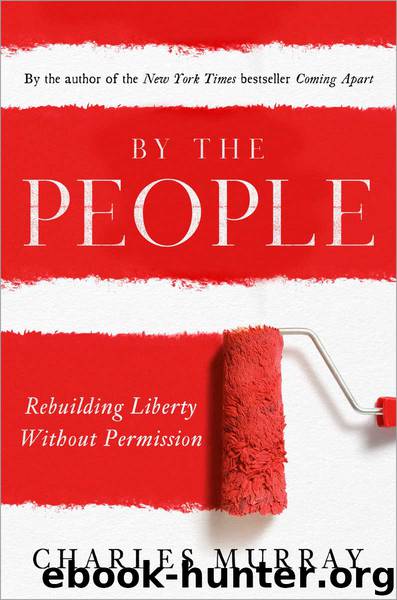
Author:Charles Murray [Murray, Charles]
Language: eng
Format: epub
Publisher: The Crown Publishing Group
Published: 0101-01-01T00:00:00+00:00
One of the most common criticisms of bureaucrats, so common that it has been a cliché around the world for centuries, is that they interpret the rules according to the absolute letter of the rule without regard to circumstances. Why has this been such a universal characteristic of bureaucrats? For two reasons. One is that they cannot be criticized by their superiors if they have followed the letter of the rule. The other is a sad commentary on human nature, but it has been confirmed by experience over millennia: people who are given the right to order other people to do things tend to exercise that power mindlessly.
Courts such as this one, following the Supreme Court’s guidance in Overton v. Volpe, have refrained from substituting their judgment for that of the regulatory agencies when applied to complex regulations based on technical analyses of abstruse scientific issues. Our case does not dispute that position. But none of the regulations putatively violated by Lancaster Brick Company are either complex or abstruse. OSHA has given its scientific rationale for requiring that beach sand be labeled POISON—that under some circumstances beach sand may cause cancer. We argue that you as judges are free to decide that such a rationale as applied to the environment of the Lancaster Brick Factory is so devoid of common sense that it is arbitrary and capricious. OSHA has given its scientific rationale for prohibiting dust masks being used by people with beards—that under some circumstances, the worker will be exposed to a health hazard. But you as judges are free to decide that the OSHA inspector who cited it as a violation was so oblivious of the facts of this particular case that the inspector’s decision to cite it as a violation was arbitrary and capricious.
We understand that interpreting “arbitrary and capricious” for any specific case is a judgment call. So is the interpretation of “guilty beyond a reasonable doubt” in criminal cases, or the interpretation of “duty of care” in civil cases. “Arbitrary and capricious” can be explicated as other legal terms of art have been explicated, but in a way that captures this elemental truth: a regulatory agency’s actions, findings, and conclusions can have gone through the motions of taking relevant considerations into account, and can appeal to some rationale, and still be obviously arbitrary and capricious when viewed in the context of the specific real-life situation in which they are applied.
To evaluate “arbitrary and capricious” in the context of specific real-life situations would bring regulatory law into the realm in which ordinary civil law and criminal law have abided for centuries. In common law, circumstances surrounding the actual event in litigation have always been at the center of attention. In criminal law, mitigating circumstances have always been taken into account. Only regulatory law has been sheltered from the requirement that it be enforced in the context of circumstances.
The deference of administrative judges and the Article III courts to the regulators has gone too far. Even assuming
Download
This site does not store any files on its server. We only index and link to content provided by other sites. Please contact the content providers to delete copyright contents if any and email us, we'll remove relevant links or contents immediately.
| Anarchism | Communism & Socialism |
| Conservatism & Liberalism | Democracy |
| Fascism | Libertarianism |
| Nationalism | Radicalism |
| Utopian |
The Secret History by Donna Tartt(19103)
The Social Justice Warrior Handbook by Lisa De Pasquale(12197)
Thirteen Reasons Why by Jay Asher(8919)
This Is How You Lose Her by Junot Diaz(6894)
Weapons of Math Destruction by Cathy O'Neil(6284)
Zero to One by Peter Thiel(5808)
Beartown by Fredrik Backman(5767)
The Myth of the Strong Leader by Archie Brown(5513)
The Fire Next Time by James Baldwin(5454)
How Democracies Die by Steven Levitsky & Daniel Ziblatt(5225)
Promise Me, Dad by Joe Biden(5157)
Stone's Rules by Roger Stone(5091)
A Higher Loyalty: Truth, Lies, and Leadership by James Comey(4966)
100 Deadly Skills by Clint Emerson(4931)
Rise and Kill First by Ronen Bergman(4797)
Secrecy World by Jake Bernstein(4756)
The David Icke Guide to the Global Conspiracy (and how to end it) by David Icke(4723)
The Farm by Tom Rob Smith(4517)
The Doomsday Machine by Daniel Ellsberg(4493)
